ZeroUSV Leads UKDI-Backed Project to Develop Autonomous Underwater Sensing Network
Addressing the challenge of underwater communications
ZeroUSV is leading a collaborative project with Oshen and MarineAI, supported by UK Defence Innovation (UKDI), to develop an autonomous sensing network designed to support underwater operations. The project combines ZeroUSV’s Oceanus12, Oshen’s C-Star uncrewed surface vessels and MarineAI’s GuardianAI software to explore how the position and operational status of underwater assets can be monitored without relying on continuous direct communications. The work has potential applications in defence, seabed mapping and the protection of critical subsea infrastructure.
Underwater platforms can perform a range of missions, from seabed mapping and infrastructure monitoring to intelligence, surveillance and reconnaissance (ISR). However, maintaining awareness of their position and operational status can be challenging when direct communications are undesirable or could compromise a mission.
High-bandwidth radio communications are not practical underwater, while requiring a submerged platform to surface for communications can compromise its concealment. The project therefore explores an alternative approach: deploying autonomous surface vessels that can passively detect acoustic signals from underwater assets.
The aim is to provide greater awareness of underwater activity while reducing the need for direct communications with the submerged platform.
Oceanus12 to deploy a network of C-Star vessels
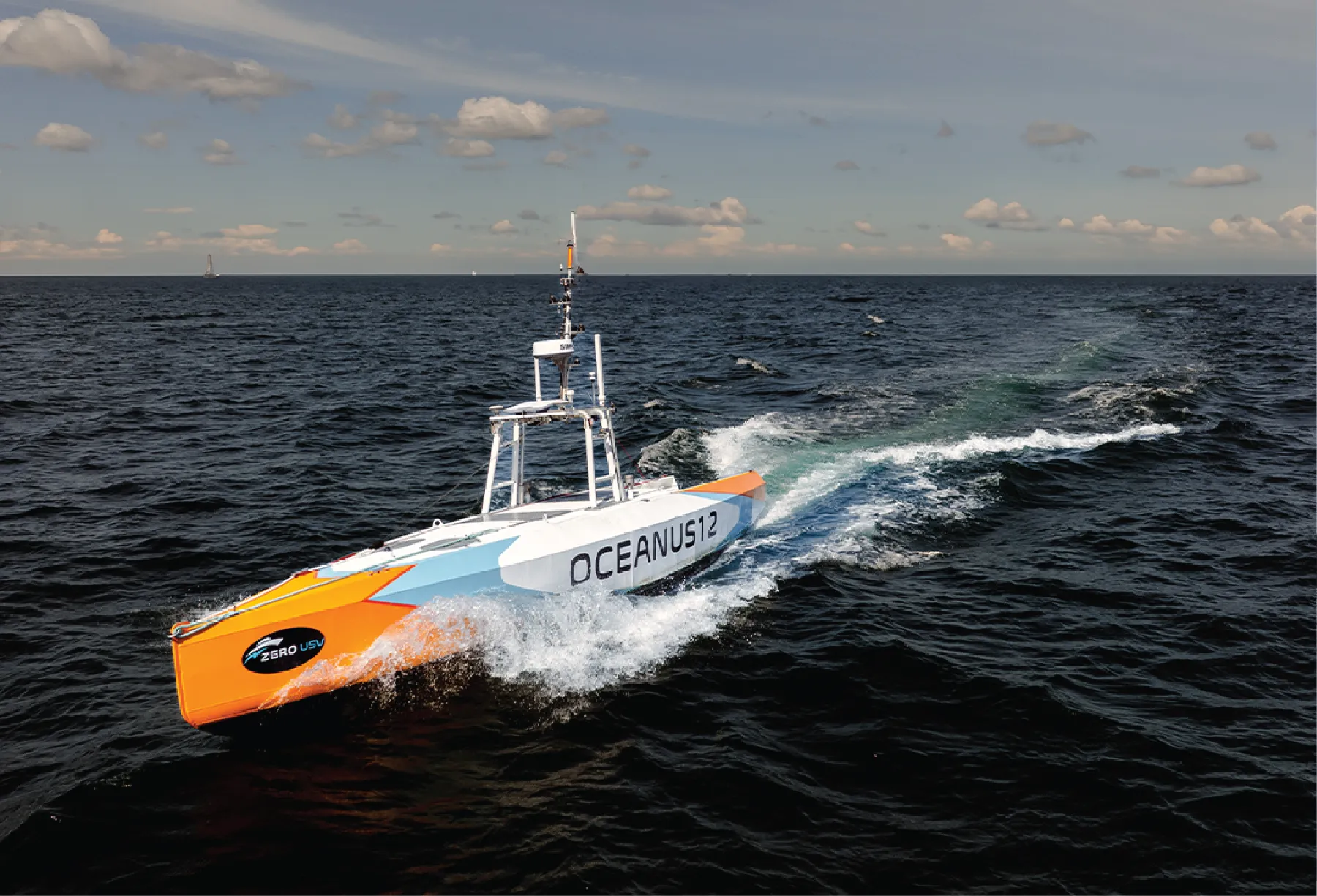
At the centre of the project is ZeroUSV’s Oceanus12, a 12-metre autonomous uncrewed surface vessel designed for long-endurance operations.
During the planned trials, Oceanus12 will autonomously transport and deploy a group of Oshen C-Star vessels across a designated area of sea. Once deployed, the C-Stars will form a distributed passive acoustic sensing network intended to detect signals from underwater platforms. The trials will use XV Excalibur as a representative Extra Large Uncrewed Underwater Vehicle (XLUUV).
Rather than relying on a single sensing point, the distributed network is designed to provide coverage across a wider area, helping confirm the presence and progress of underwater assets during a mission.
Integrating autonomous systems
The project brings together the capabilities of three companies, with each contributing a different element of the system.
ZeroUSV is leading the project and providing Oceanus12 as the deployment platform. The vessel will carry and launch the C-Star craft, enabling their coordinated deployment across the operational area.
Oshen is providing its C-Star uncrewed surface vessels, designed for long-endurance operation and use in distributed sensing networks. Their role in the project is to provide the surface-based platforms for passive acoustic monitoring.
MarineAI will integrate the C-Star launch and deployment system with its GuardianAI autonomy software aboard Oceanus12. This integration is intended to support autonomous mission planning, deployment and coordinated operation across multiple vessels.
A central challenge is demonstrating not simply that the individual platforms can operate autonomously, but that multiple autonomous systems can plan, deploy and operate as a coordinated network.
Applications in defence and subsea infrastructure protection
The proposed sensing network could support several underwater missions where persistent monitoring and situational awareness are important.
Potential applications include intelligence, surveillance and reconnaissance, seabed mapping, monitoring subsea cables and pipelines, and supporting the operations of uncrewed underwater platforms.
For defence organisations, the approach could provide an additional means of monitoring underwater assets while limiting reliance on direct communications. For critical national infrastructure, the distributed sensing network could contribute to broader situational awareness around subsea cables, pipelines and other strategically important assets.
The project is intended to explore the feasibility of this approach rather than represent a fully operational capability. Its effectiveness will depend on the results of integration work and sea trials.
UK Defence Innovation support
The collaboration received funding through UK Defence Innovation (UKDI), which incorporates the former Defence and Security Accelerator (DASA). The programme will progress through an initial phase of design, system integration and sea trials to develop and test the autonomous underwater sensing concept.
The findings are expected to inform future concepts for UK and allied underwater operations. By combining autonomous deployment, passive acoustic sensing and coordinated software, the project seeks to demonstrate how networks of uncrewed vessels could support more resilient underwater monitoring.
For ZeroUSV, the programme will also explore how autonomous surface vessels can act as more than standalone platforms: they can serve as deployment and coordination assets within a wider network of maritime and underwater systems.
Media coverage
The project has been covered by maritime, defence and technology publications, including:
-
Inside Marine — UKDI backs joint project on autonomous underwater sensing
-
Ocean News — UKDI backs joint project on autonomous underwater sensing
-
The Maritime Executive — UK Tests Out Drone Boats for Maintaining Comms with Submersibles
-
Maritime Journal — UK funds autonomous subsea sensing network
-
Janes — ZeroUSV, Oshen and MarineAI to develop communications for underwater platforms


- 12 March 2024
Zero USV to Launch World’s First High Endurance Open Ocean Autonomous Vessel Fleet – Oceanus12

- 7 March 2024