AI and Autonomous USVs: Expanding Marine Survey and Ocean Data Collection
Meeting the demand for marine data
Artificial intelligence (AI) and autonomous uncrewed surface vessels (USVs) are changing how organisations collect, process and use marine data. From seabed mapping and offshore wind development to oceanographic research and environmental monitoring, advances in onboard computing and autonomous navigation are creating opportunities for longer-duration operations with reduced reliance on crewed vessels. For ZeroUSV, these developments underpin autonomous platforms designed to support an increasingly diverse range of maritime missions.
The expansion of offshore renewable energy, subsea infrastructure and marine research is increasing demand for accurate, reliable data about the seabed and ocean environment.
Offshore wind developments, for example, require detailed seabed surveys during site assessment, construction and throughout the operational life of an installation. Hydrographic and geophysical data are also important for subsea cables, telecommunications infrastructure, offshore energy projects and environmental studies.
Traditionally, these operations have relied heavily on crewed survey vessels, bringing costs associated with personnel, vessel support and extended time at sea. Autonomous USVs offer an alternative for suitable missions, with the potential to remain operational for longer periods and collect data across extensive areas without carrying crew.
As offshore industries and ocean research expand, autonomous technology could help organisations improve survey efficiency, reduce personnel exposure to challenging marine environments and undertake marine data collection over longer periods and greater distances.
AI enables greater autonomy at sea
A key development in autonomous maritime operations is the ability to process information and make decisions onboard a vessel, rather than relying entirely on continuous instructions from shore.
Advances in graphics processing units and onboard computing have made it possible to deploy AI models directly on relatively compact, energy-efficient hardware. This approach, often described as edge computing, allows autonomous systems to process sensor information and support navigation decisions locally.
For operations beyond the horizon, this capability is particularly important. Satellite communications and other connectivity systems can provide monitoring and operational coordination, but an autonomous vessel must also be capable of managing its core functions when a connection is interrupted or unavailable.
Autonomous navigation systems can combine information from marine radar, Automatic Identification System (AIS) data and computer vision to build situational awareness, identify potential obstacles and support safe navigation and collision avoidance.
From collecting data to generating insight
The potential of AI extends beyond vessel navigation. Autonomous platforms can collect marine data over extended periods, while AI-assisted processing can help identify patterns, anomalies and changes within large datasets.
In ocean science, AI-assisted analysis could support the monitoring of water temperature, salinity, ocean currents and marine life activity. Consistent data collection may help researchers better understand environmental changes that are difficult to capture through short, occasional survey campaigns.
AI can also support offshore energy projects by helping analyse seabed information, identify relevant environmental features and improve the efficiency of survey workflows. In marine conservation, similar techniques could assist with habitat monitoring, species identification and the detection of potential environmental threats.
These applications depend on the quality of the sensors, the data collected and the analytical systems used. AI can accelerate analysis and support expert decision-making, but scientific conclusions still require appropriate validation and interpretation.
Oceanus12: bringing autonomy and sensing together
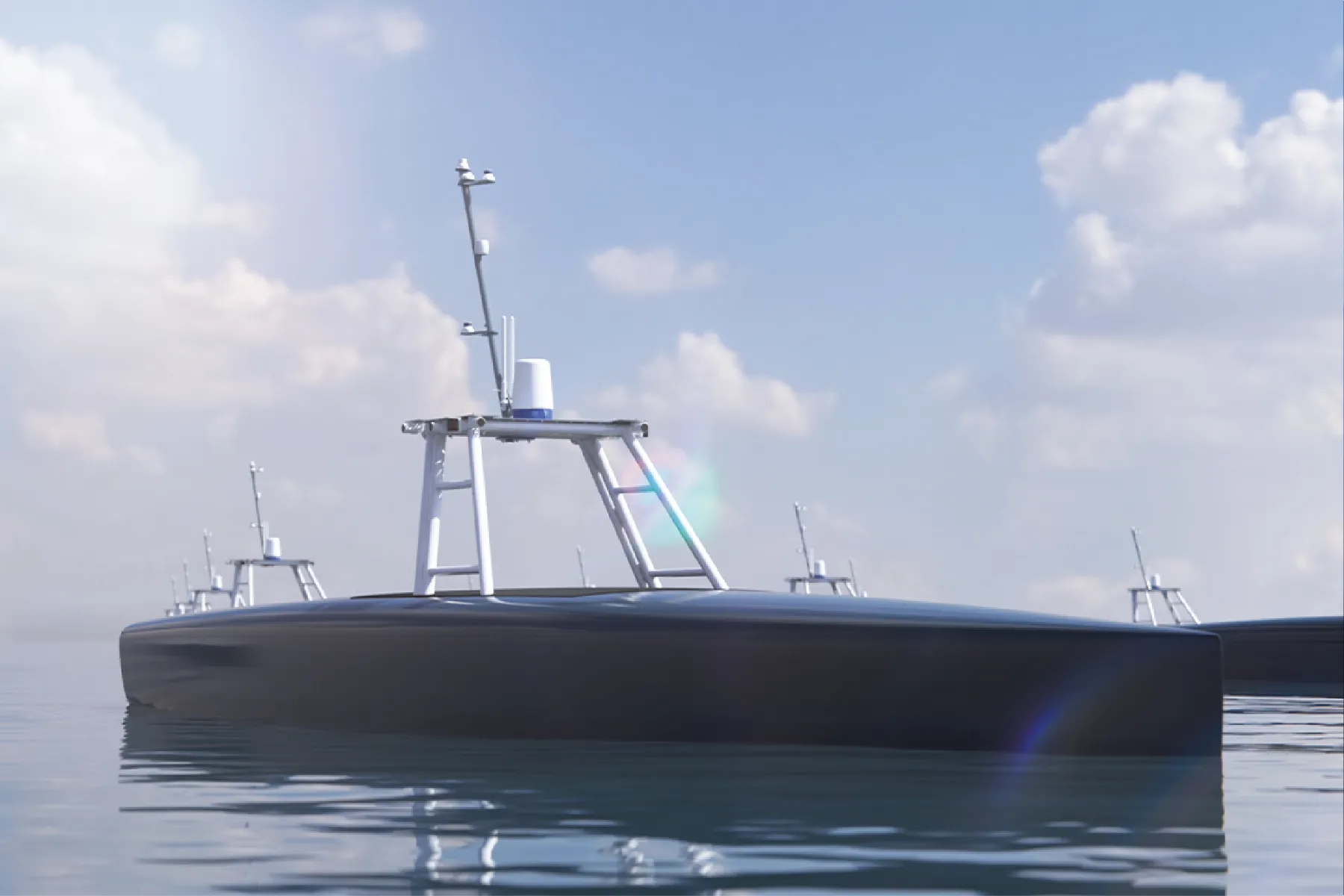
ZeroUSV’s Oceanus12 is designed to combine autonomous navigation, onboard computing and marine sensor technology in a long-endurance uncrewed surface vessel.
The platform uses GuardianAI, developed by MarineAI, to support autonomous navigation and onboard decision-making. Its modular payload architecture allows it to be configured for different operational requirements, including hydrographic surveying, seabed mapping, oceanographic data collection and offshore monitoring.
Oceanus12 combines hybrid-electric propulsion with an uncrewed configuration designed for extended offshore operations. Without the accommodation, provisions and other support requirements associated with carrying crew, more of the platform can be dedicated to mission capability and endurance.
By integrating vessel engineering, autonomy software and sensor systems, the platform is intended to support missions where endurance, operational flexibility and reliable data collection are important.
Connectivity, safety and operational efficiency
Autonomous vessels must operate within a complex maritime environment, accounting for commercial traffic, navigational hazards, marine life and changing sea conditions. Their ability to function independently therefore depends on more than simply following a pre-programmed route.
Developments in satellite connectivity and hybrid communications can improve links between vessels and shore-based teams. Combined with onboard processing, these systems can support remote oversight while allowing the vessel to maintain essential autonomous functions when communications are disrupted.
AI can also contribute to route planning, speed optimisation and the organisation of survey missions. These capabilities have the potential to improve operational efficiency and reduce some costs associated with data acquisition.
However, autonomous operations still require appropriate mission planning, suitable equipment, regulatory compliance and effective operational oversight. Their benefits depend on matching the vessel’s capabilities and configuration to the requirements of each mission.
Expanding autonomous marine data collection
The convergence of AI, autonomous navigation and marine sensing creates opportunities across offshore energy, surveying, oceanographic research and environmental monitoring.
As the demand for marine data grows, USVs could provide a more flexible way to undertake extended survey and monitoring missions, while AI-assisted analysis helps turn collected information into useful operational and scientific insight.
For ZeroUSV, Oceanus12 reflects this shift towards long-endurance autonomous maritime operations. By combining vessel engineering, onboard autonomy and adaptable sensor capability, platforms such as Oceanus12 can provide a practical means of extending how organisations survey, monitor and understand the marine environment.
Media coverage
Related commentary from ZeroUSV and MarineAI on AI, maritime autonomy, marine surveying and ocean science has appeared in publications including:


- 12 March 2024
Zero USV to Launch World’s First High Endurance Open Ocean Autonomous Vessel Fleet – Oceanus12

- 7 March 2024